跳到内容
跳到内容 
The EU Packaging and Packaging Waste Regulation (PPWR) 1 is fundamentally reshaping procurement, but compliance shouldn't turn into a chaotic redesign exercise.
As an offset packaging manufacturer with over 16 years on the press floor, I work daily with seasoned European procurement leads. When PPWR comes up, the most experienced buyers don't waste time asking vague questions like "Is this box PPWR-compliant?" They skip the sales pitch and ask us for a transparent, component-level Bill of Materials (BOM) layer by layer.
While August 12, 2026 marks the general application date, different requirements follow phased enforcement timelines. Before scrapping viable inventory or altering active production runs, the most practical step you can take today is auditing what your packaging is physically made of.
Does PPWR Require Every Package to Change in August 2026?
A single PPWR date does not tell buyers whether a specific box, bag, label, insert, or coating needs to change. Each packaging format needs to be checked against the requirements that apply to it.
No. PPWR generally applies from August 12, 2026, but individual requirements follow phased enforcement dates. Buyers should audit applicable rules rather than scrapping viable packaging.

Understanding the PPWR Timeline
Just last month, a French skincare client panicked and demanded we strip all lamination off his 350gsm folding cartons to "beat the deadline." I stopped the job ticket immediately. On our press lines, removing outer protective film without structural testing meant boxes would rub against each other during ocean freight, causing ink scuffing and high damage rates—creating far more waste than the plastic film itself.
While August 12, 2026 marks the general application date, immediate bans target specific areas like PFAS limits in food-contact packaging 2. Other structural and recyclability requirements follow different implementation timelines 3.
What Does August 2026 Actually Mean?
I prefer to separate the general application date from individual requirement deadlines.
| Buyer Question | Better Approach |
|---|---|
| Must all current packaging be replaced? | Check the applicable requirement and date |
| Is every plastic component prohibited? | Assess the specific format and requirement |
| Is a paper box automatically compliant? | Review the complete packaging structure |
| Does FSC prove PPWR compliance? | No. FSC addresses fibre sourcing, not full PPWR compliance |
| Should existing inventory be discarded? | Check applicable obligations first |
Instead of making drastic, unverified material swaps, buyers should identify exact material layers and coating chemistry before making changes.
Why Should Buyers Start Reviewing New Packaging Now?
A packaging design approved on our press floor today will likely stay in production for the next two to three years across multiple reorders.
Buyers should review new packaging now because establishing accurate material files during standard sampling makes future compliance audits effortless.

Planning Packaging for Future Requirements
Auditing packaging is standard supply chain maintenance. Once we set up steel dies, foil plates, and molds, the core rigid board, insert layout, and closures usually outlive seasonal artwork revisions.
Start With the Next Packaging Project
I would start reviewing packaging when:
- a new package is developed;
- an existing package is reordered;
- a material or structure is changed;
- a new supplier is approved;
- a product enters the EU market.
If your PO simply says "350gsm paperboard," you will struggle in 2028 when an auditor asks whether the lamination was BOPP or PET, or if the mounting adhesive was hot-melt or water-based. Logging those batch specs in our sample room takes minutes and saves months of retrospective tracking.
Build a Baseline Before You Need It
| Information | Why Record It Now? |
|---|---|
| Main material | Shows the basic packaging construction |
| Coating or lamination | Identifies additional material layers |
| Window and insert | Shows important secondary components |
| Finished weight | Creates a baseline for later comparison |
| Packaging version | Helps match records to the actual product |
Building this specification file during artwork approval creates a clean historical baseline to compare physical prototypes directly against future requirements.
What Material Information Should Suppliers Provide?
Broad sales claims like “eco-friendly paper box” are completely useless on a manufacturing specification sheet.
Buyers should ask suppliers for exact component-level specifications, detailing the structural substrate, laminates, barrier coatings, window films, inserts, adhesives, and decorative hardware.

Checking Complete Packaging Materials
On our engineering tables, a luxury gift box is a complex assembly: greyboard cores, wrapped specialty paper, hidden neodymium magnets, ribbon pulls, and EVA foam or molded pulp trays. That is why we provide an itemized BOM rather than marketing slogans.
Look Beyond the Main Paperboard
| Packaging Component | Information to Confirm |
|---|---|
| Main board | Paper or board type, thickness or GSM |
| Lamination | Film type and location |
| Coating | Coating type and purpose |
| Window | PET, PP, PLA, or another material |
| Insert | Paper, molded pulp, PET, foam, or another material |
| Adhesive | Adhesive type where relevant |
| Accessories | Magnets, metal parts, ribbons, handles |
| Components | Whether important parts can be separated |
We ran into this with a German fragrance client whose rigid gift boxes failed single-material recycling guidelines. They didn't want to sacrifice the premium magnetic unboxing experience, but they needed compliance.
Instead of forcing a high-MOQ commitment, we engineered two physical alternatives within 3 days: a paper-interlock catch and a concealed removable magnet channel. By running a low-risk trial batch of just 100 units, they verified real-world transit durability and compliance before placing a mass-production order.
Avoid Relying on Broad Environmental Claims
Generic descriptions like "eco-friendly packaging" provide zero technical accountability during customs audits. Furthermore, an FSC certificate alone doesn't grant full PPWR compliance—FSC verifies responsible wood fibre sourcing 4 at the paper mill, but says nothing about laminations, inks, or adhesives added during box assembly.
Which Packaging Structures Need Closer Attention?
A package can look simple while containing multiple glued layers or excessive air pockets. These structures deserve an engineering review.
Buyers should focus on multi-material combinations, excessive empty space, heavy foam inserts, window films, and barrier coatings.
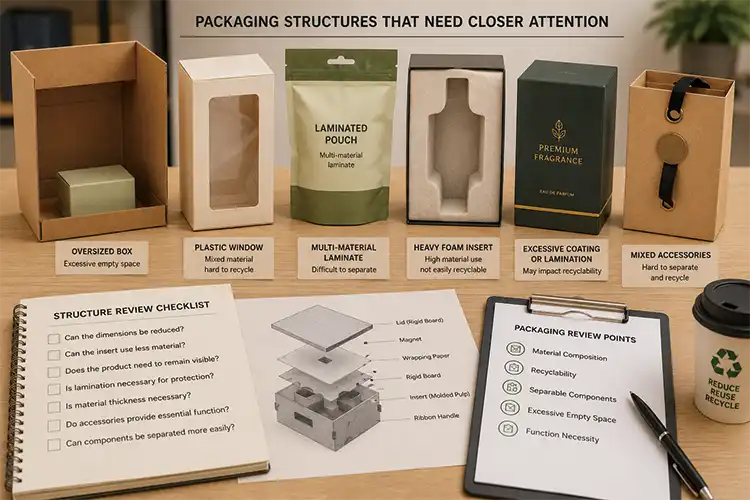
Reviewing Packaging Structure and Materials
On the factory floor, every layer must justify its function—heavy board provides stacking strength during ocean freight, while inserts lock fragile glass containers in place.
Check Materials and Empty Space Together
| Packaging Feature | Question I Would Ask |
|---|---|
| Oversized box | Can the dimensions be reduced? |
| Heavy insert | Can the insert use less material? |
| Plastic window | Does the product need to remain visible? |
| Lamination | Is it needed for protection or mainly appearance? |
| Thick paperboard | Is this thickness required for performance? |
| Decorative accessories | Do they provide a necessary function? |
| Mixed materials | Can the components be separated more easily? |
PPWR also makes packaging minimisation and excessive empty space 5 important considerations when buyers review box dimensions and structural efficiency.
Trimming material thickness blindly is a recipe for crushed boxes. If reducing board weight causes cartons to collapse during transport, the resulting product destruction creates far more environmental waste than the paper saved.
Food-Contact Packaging Needs Extra Questions
If you manufacture food-contact cartons, bakery sleeves, or oil-based cosmetics, grease-resistant barriers are your biggest liability. But asking a supplier "Is your paper PFAS-free?" is a rookie mistake.
We recently audited a project where the raw paper mill held a clean PFAS-free certificate. However, when we tested the final printed, glued box, trace contamination showed up from downstream converting inks and edge glues. Real factory control means testing the finished, converted packaging assembly rather than waving an outdated raw paper spec sheet.
What Documents Should Buyers Request From Suppliers?
A casual email confirmation offers zero protection during an official regulatory audit.
Buyers should build a comprehensive packaging file containing raw material specifications, component BOMs, finished weight logs, supplier declarations, third-party test reports, and version-controlled job tickets.
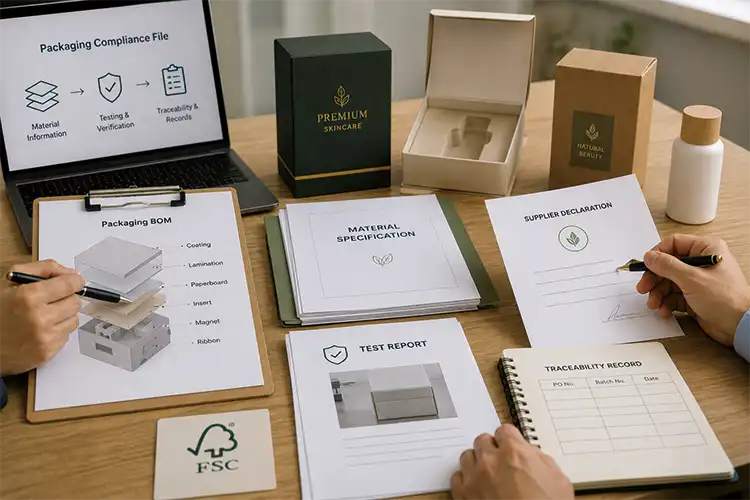
Building Better Packaging Documentation
Build a Basic Packaging File
| Document or Record | Purpose |
|---|---|
| Material specification | Identifies packaging materials |
| Bill of packaging materials | Breaks the structure into components |
| Packaging weight record | Provides a material baseline |
| Supplier declaration | Records supplier-provided information |
| Test report | Supports specific tested properties |
| Food-contact declaration | Supports relevant food-contact assessment |
| PFAS statement or test | May be relevant for food-contact packaging |
| Version record | Links documents to the correct packaging version |
Any supplier telling you "our single factory certificate covers 100% of your EU compliance liability" is selling a fantasy. On our engineering tables, a luxury gift box is a complex assembly: greyboard cores, paperboard and specialty paper, hidden neodymium magnets, ribbon pulls, and EVA foam or molded pulp trays.
How Can Buyers Prepare Without Redesigning Everything?
Overhauling your entire packaging line at once inflates tooling costs and delays product launches. A modular approach is far more effective.
Buyers can prepare smoothly by auditing packaging during standard reorder cycles—testing simplified structures, lowering material weights, and validating performance before committing to large-scale production.
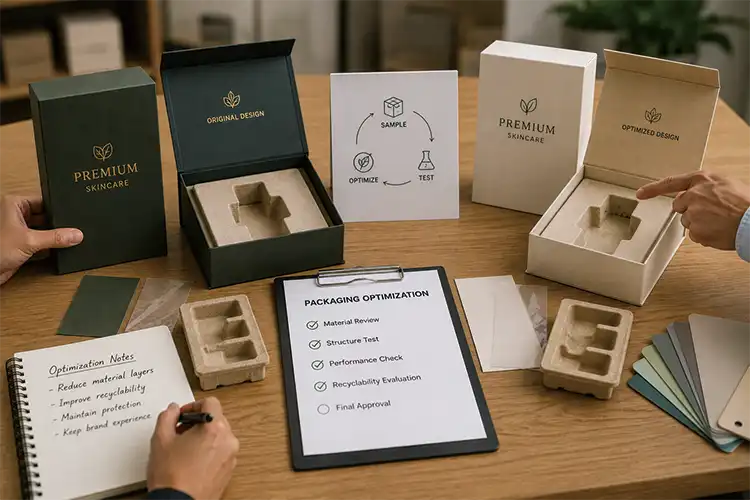
Preparing for PPWR Step by Step
Focus on upcoming product launches and scheduled reorders. New developments offer the perfect testing ground because structural parameters and tooling aren't locked in yet.
This also creates a practical opportunity to review packaging minimisation and recyclability requirements 6 before the structure is locked in.
Ask Questions That Produce Useful Answers
| Instead of Asking | Ask the Supplier |
|---|---|
| Is this PPWR compliant? | What materials and components are used? |
| Is this recyclable? | Can the mixed components be separated? |
| Is this eco-friendly? | Can you provide the current material specification? |
| Can you make it lighter? | What material can be reduced without affecting protection? |
| Can we remove plastic? | What alternative structure would you recommend? |
| Is the alternative better? | Will it still protect the product during transport? |
Transitioning to compliant packaging shouldn't feel like a high-risk gamble. Working with an agile, flexible manufacturing setup makes all the difference:
- Rapid Prototyping (3-Day Sampling): Test structural modifications, unlaminated boards, or mono-material paper inserts with physical samples in 72 hours to verify strength before mass production.
- Low-Risk Validation (100-Unit MOQ): Run small 100-piece pilot batches to conduct real-world shipping and drop tests without tying up cash flow.
- Flexible Production (15-Day Delivery): Scale up to full production runs seamlessly once transit tests pass, keeping launch schedules completely intact.
Conclusion
Managing PPWR isn't a sudden crisis—it is disciplined supply chain iteration. Ask for exact BOMs on your next reorder, log component weights, and test optimized structures step by step through low-risk sample runs to stay ahead of regulation without wasting money.
-
Read the official PPWR text and verify the regulation, scope, requirements, and implementation framework directly from the EU legal source. ↩
-
Check the official PPWR limits for PFAS in food-contact packaging and see when these restrictions begin to apply. ↩
-
See how major PPWR requirements are phased over time and understand which packaging changes may require earlier planning. ↩
-
Learn what FSC Chain of Custody actually verifies and why FSC certification does not cover every material in finished packaging. ↩
-
Understand how PPWR packaging minimisation affects box size, empty space, material use, and practical packaging design decisions. ↩
-
Explore the EU’s broader PPWR goals for reducing packaging waste, limiting material use, and improving packaging recyclability. ↩