跳到内容
跳到内容 
Many food brands see grease stains and immediately ask for thicker paper. They spend more money on higher GSM paperboard, yet the stains often return.
Thicker paper may slow grease migration, but it rarely stops it. In most cases, grease stains appear because oil moves through paper fibers, and paper thickness alone cannot block that movement.
I have seen brands upgrade from 300gsm to 400gsm without solving the problem. Before increasing GSM, it is important to understand what actually causes grease stains and how food packaging performs in real-world conditions.
Why Do Many Buyers Think Thicker Paper Solves Grease Problems?
Many buyers assume thicker paper provides better grease protection because GSM is easy to compare. While thicker paper can improve box strength, it does not automatically prevent oil migration.
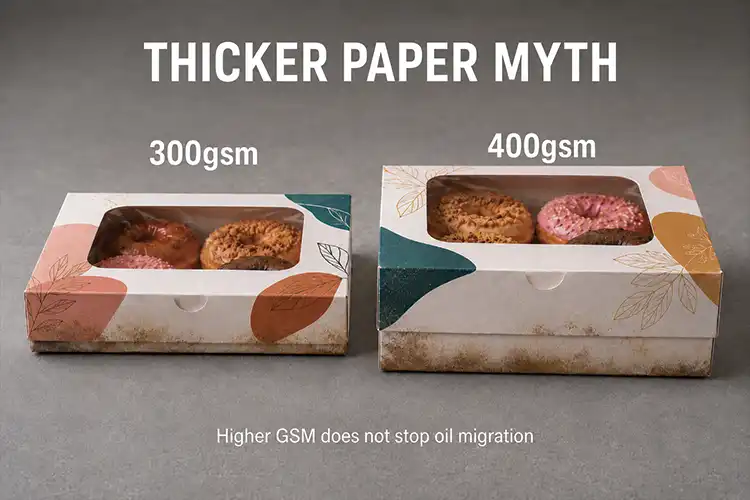
THICKER PAPER MYTH
A bakery customer once asked us to upgrade a pastry box from 300gsm to 400gsm because grease marks appeared on the bottom panel.
The new boxes felt stronger. The customer believed the problem was solved.
Three weeks later, the same grease marks appeared again.
That project taught me that GSM and grease resistance are two different things.
Many buyers focus on GSM because it is visible on every quotation sheet. A larger number feels safer and easier to justify.
The problem is that grease does not behave like weight or pressure. Oil can still move through the paper structure if pathways remain open.
| Benefit | Does Higher GSM Help? |
|---|---|
| Box stiffness | Yes |
| Stacking strength | Usually |
| Premium feel | Yes |
| Grease resistance | Not necessarily |
When grease stains appear, I rarely start by discussing paper weight. I first look at the food itself, how long it stays inside the package, and what happens during transportation.
Why Can Oil Still Leak Through 400gsm Paperboard?
Oil can still leak through 400gsm paperboard because paper is made from compressed fibers rather than a solid barrier. Small spaces remain between fibers, allowing grease to move through the board over time.
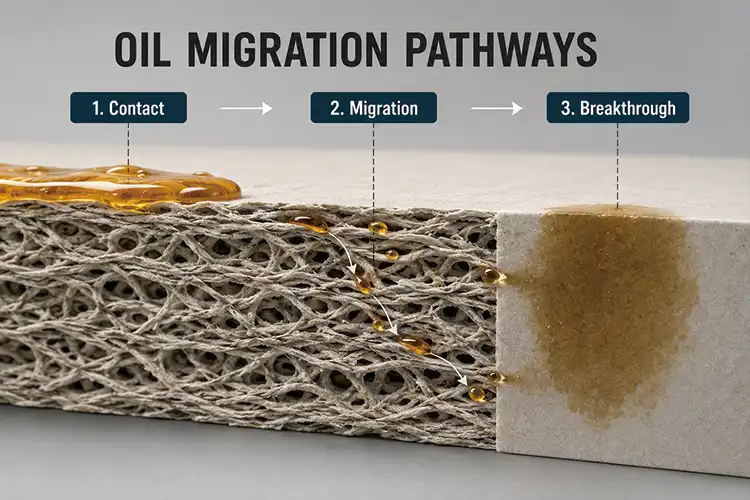
OIL MIGRATION PATHWAYS
Many buyers expect thick paperboard to act like a wall.
Paper does not work that way.
Even high-GSM paperboard contains microscopic spaces between fibers 1. When oil touches the surface, it can slowly enter those spaces and continue moving through the material.
| Stage | What Happens |
|---|---|
| Contact | Oil touches paper |
| Migration | Oil moves through fibers |
| Breakthrough | Oil appears outside |
This explains why a package may look perfect during packing but show stains later.
The key issue is not paper thickness, is whether the paper structure allows oil to migrate. This process is commonly evaluated using standard grease resistance testing methods 2.
Why Do Packaging Samples Pass but Retail Packaging Fails?
Packaging samples often pass because testing periods are short and controlled. Retail packaging faces longer storage times, transportation pressure, and real food contact, which can expose problems hidden during sample reviews.
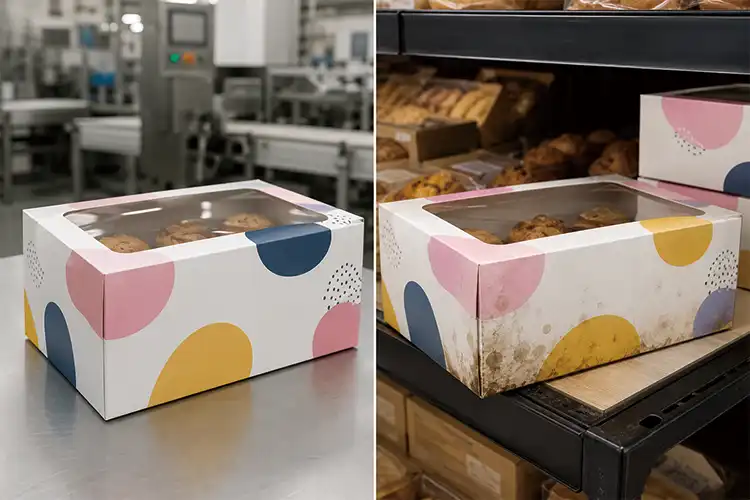
FACTORY VS RETAIL CONDITIONS
One donut box sat on my desk for thirty minutes.
It looked perfect.
No stains appeared.
Several days later, the same box sat inside a retail display.
Grease rings appeared around the lower corners.
The box passed the factory review.
The box failed in the real market.
Most sample evaluations focus on appearance, printing quality, and structure. These checks are important, but they do not always reflect actual use conditions.
Laboratory performance should always be compared with real food-contact packaging conditions 3.
| Condition | Sample Review | Retail Environment |
|---|---|---|
| Time | Minutes | Days |
| Temperature | Stable | Variable |
| Stacking | Minimal | Frequent |
| Transportation | None | Continuous |
The longer food remains inside a package, the more opportunity grease has to migrate.
That is why I always recommend testing with the actual product under realistic storage and transportation conditions.
What Factors Make Grease Migration Worse During Shipping?
Heat, storage time, stacking pressure, and food oil content all increase grease migration risk. These factors often determine whether packaging succeeds or fails after leaving the factory.
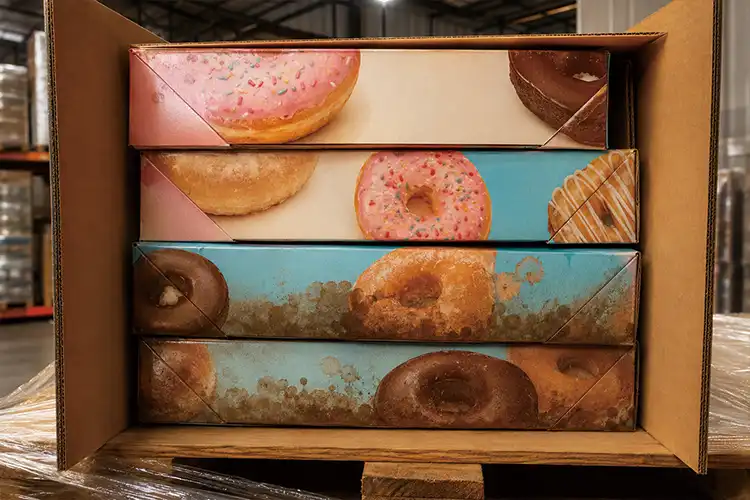
GREASE RISK FACTORS
The environment plays a major role in packaging performance.
A package that works well for local delivery may perform very differently during long-distance distribution.
| Factor | Impact |
|---|---|
| Heat | High |
| Storage Time | High |
| Oil Content | High |
| Stacking Pressure | Medium |
I often see brands focus on paper specifications while ignoring logistics.
In reality, the same package can perform differently depending on how long the food stays inside and how it is transported.
That is why shipping conditions should be reviewed before changing materials.
What Mistakes Do Buyers Make When Choosing Paperboard GSM?
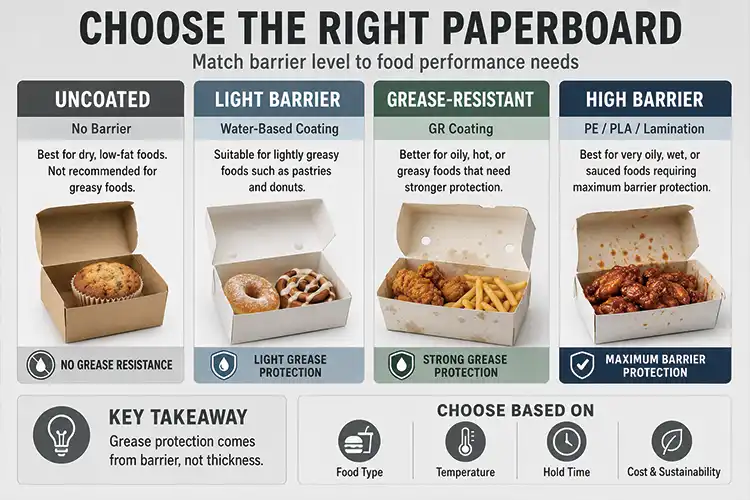
The biggest mistake is assuming that higher GSM automatically means better grease protection. While thicker paper may improve strength, it does not guarantee resistance to oil migration.
GSM BUYER MISTAKES
Many grease-related projects begin with the wrong diagnosis.
The customer sees grease stains and immediately requests thicker paper.
In many cases, the actual cause lies elsewhere.
| Buyer Assumption | Factory Reality |
|---|---|
| 400gsm stops grease | Not always |
| Higher GSM means better protection | Often false |
| Grease stains mean paper is too thin | Usually incomplete |
| A clean sample guarantees success | Long-term testing is still needed |
Before changing GSM, I recommend identifying the actual failure point.
| Problem | Likely Cause | Better Direction |
|---|---|---|
| Box bends | Weak structure | Higher GSM or stronger design |
| Corners crush | Load issue | Structural improvement |
| Oil stains appear | Grease migration | better grease resistance solutions 4 |
| Product freshness declines | Barrier issue | Improved barrier system |
In my experience, most unnecessary material upgrades happen because the problem is diagnosed too quickly.
The more accurately the problem is identified, the less money usually gets wasted.
In my experience, most unnecessary material upgrades happen because the problem is diagnosed too quickly.
The more accurately the problem is identified, the less money usually gets wasted.
Not sure whether your packaging issue is caused by paper strength or grease migration?
We can review your food product, packaging structure, and distribution conditions to help identify the cause before you invest in thicker paperboard or new materials.
You may also find these resources helpful:
Frequently Asked Questions
How long should I test food packaging before approving mass production?
Test packaging with the actual food under normal storage and transportation conditions for the expected holding period. Many grease issues only appear after several hours or days, not during a short sample review.
What specification should I request from suppliers besides GSM?
For oily food packaging, request grease-resistance data, barrier information, and food-contact compliance in addition to GSM. GSM alone does not indicate how well a paperboard resists oil penetration.
What is a Kit Test, and when does it matter?
A Kit Test 5 measures how well paper resists oil and grease penetration. It becomes especially important when sourcing packaging for fried foods, pastries, pizza, and other high-fat products.
What is the most common mistake buyers make when dealing with grease stains?
The most common mistake is assuming the paper is too thin. In many cases, grease stains are caused by oil migration, storage time, or transportation conditions rather than GSM itself.
Conclusion
Grease stains are rarely caused by paper thickness alone. Correct diagnosis prevents unnecessary upgrades and leads to better packaging decisions.
-
Learn how grease penetrates paperboard and how resistance is scientifically measured. ↩
-
Understand the industry-standard test used to measure grease resistance. ↩
-
See how storage, temperature, and food oils affect packaging performance. ↩
-
See how commercial paperboard achieves grease resistance without simply increasing GSM. ↩
-
Learn how Kit Test ratings are measured and what the scores mean. ↩