跳到内容
跳到内容 
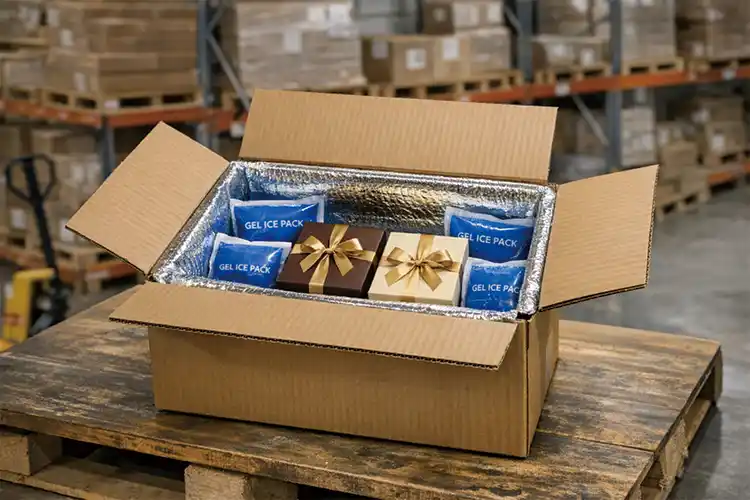
I have worked in the packaging manufacturing industry for many years. I speak with chocolate brand owners every week. Many chocolate brands want to expand into international markets. But many of them face the same problem. Their premium chocolate arrives at the customer’s door already melted. Shipping conditions are often much harsher than people expect.
Through working with chocolate exporters, I learned that chocolate starts to fail when temperatures reach around 30°C. If chocolate needs to travel internationally, a standard box is rarely enough. The packaging must work as a system. This system usually combines insulation, stable inserts, and strong outer cartons.
The quality of chocolate depends on the recipe. But the survival of the chocolate often depends on the packaging structure that protects it during transport. When we understand the risks of the journey, we can design packaging that protects the product.
Why Does Chocolate Melt During International Shipping?
Chocolate melts during international shipping because chocolate shipping environments 1 such as shipping containers, delivery vans, and airport loading areas often exceed 30°C (86°F). Packaging must act as a thermal barrier that slows heat transfer and protects the cocoa butter structure from bloom and deformation.
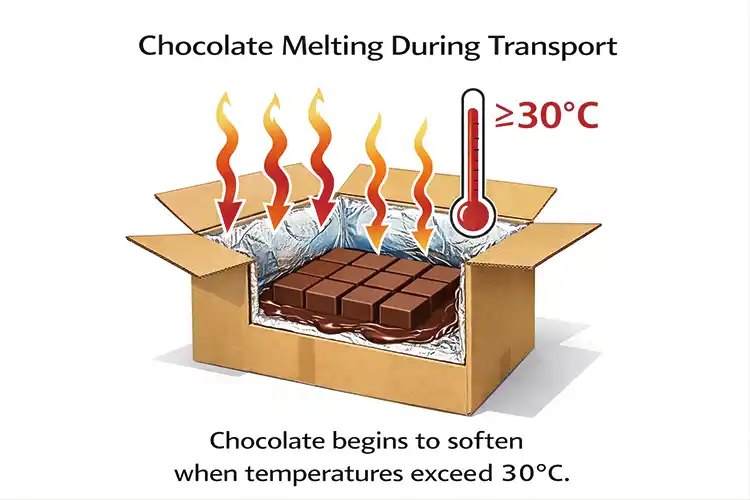
Chocolate Temperature Risk During Transport
The Hidden Heat Traps in Global Logistics
When I talk with export managers, they often focus on summer shipments. Many people assume that winter shipments are safe. In practice, heat can appear anywhere in the logistics chain.
I once worked with a client who shipped a container of chocolate truffles in February. The container crossed the equator during the journey. It stayed under strong sunlight for many days. By the time it reached the destination port, the internal temperature was extremely high. The chocolate did not only melt. It also developed fat bloom. The cocoa butter separated and the surface turned white. The customer thought the product had mold. The entire shipment became a loss.
From many shipping cases, one thing becomes clear. The most dangerous moments often happen during the “last mile” or while packages wait in logistics hubs. A box may remain in a delivery van for several hours under direct sunlight. The metal roof of the van acts like a heater. If the packaging does not slow heat transfer, the temperature inside the box can rise quickly.
In discussions with chocolate exporters, heat transfer through packaging materials is always an important topic. Many logistics teams evaluate how quickly external heat can enter a package. They look not only at paper thickness, but also at the full packaging structure and insulation layers.
Common Logistics Heat Points
| Shipping Stage | Why It Gets Hot | The Result for Your Box |
|---|---|---|
| Tarmac Loading | Direct sun on the ground | Rapid heat rise from below |
| Customs Hold | Warehouses without cooling | Long periods of high temperature |
| Local Delivery | Small vans without ventilation | Final melting before delivery |
Many exporters also study the climate along their shipping routes. If a shipment passes through desert regions or tropical ports, stronger insulation becomes necessary. Even the color of the outer carton can influence heat absorption. White cartons reflect more sunlight than dark cartons.
For a brand‑level checklist that covers weather, routes, and packaging choices, many exporters refer to practical chocolate shipping checklists 2 when planning international deliveries.
What Temperature Is Safe for Chocolate Transport?
The safe temperature range for shipping chocolate is between 15°C and 20°C (59°F–68°F). Maintaining this range helps preserve cocoa butter crystal stability and prevents bloom, texture changes, and surface discoloration.
which is consistent with recommended chocolate storage conditions 3 used by professional chocolatiers.
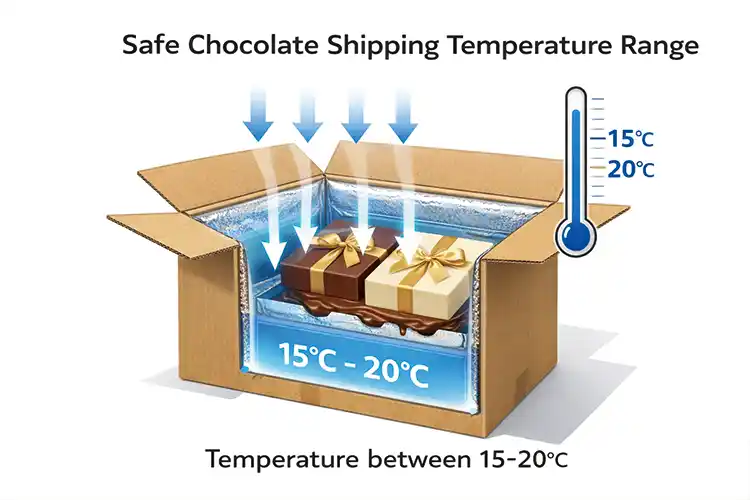
Safe Chocolate Shipping Temperature Range
Why Different Chocolates Require Different Protection
Not all chocolate behaves the same during shipping. dark, milk, and white chocolate melting points 4 vary because of their different cocoa butter, sugar, and milk content. Milk chocolate and white chocolate are usually more sensitive to heat than dark chocolate.
I once worked with a client who produced milk chocolate bars with high dairy content. When the shipping temperature reached about 24°C, the bars began to soften. Dark chocolate often remains stable until around 27°C.
Fillings introduce another challenge. One chocolate brand produced liquor-filled chocolates. When the chocolate shell warmed, the liquid filling expanded. This expansion created pressure inside the shell. If the shell was slightly thin, it cracked. The filling leaked and stuck to the packaging insert. When customers removed the product, the chocolate often broke apart.
Because of experiences like this, many chocolate brands use inserts that hold each piece firmly in place. These inserts reduce movement even if the chocolate softens slightly.
Sensitivity Levels by Product Type
| Chocolate Type | Conservative Max Shipping Temp* | Typical Packaging Approach |
|---|---|---|
| 80% Dark | ~22°C – 25°C | Standard insulation |
| Milk Chocolate | ~18°C – 22°C | Heavier insulation + gel packs |
| White / Filled | ~16°C – 20°C | Double insulation + additional cooling |
Transit time also influences packaging design. A three-day air shipment is relatively manageable. A thirty-day sea shipment creates far greater temperature risk.
For long sea shipments, some exporters use refrigerated containers. These containers maintain lower temperatures during ocean transport. However, the final delivery stage can still create problems.
In temperature-sensitive shipping, logistics teams often estimate what is called the “cold life” of a package. This describes how long a package can maintain a stable internal temperature when the outside environment becomes very hot.
What Packaging Prevents Chocolate From Melting?
The most effective packaging for chocolate shipping uses a layered thermal system. This system usually includes a strong corrugated outer carton, a reflective thermal liner, and cooling materials such as gel packs.
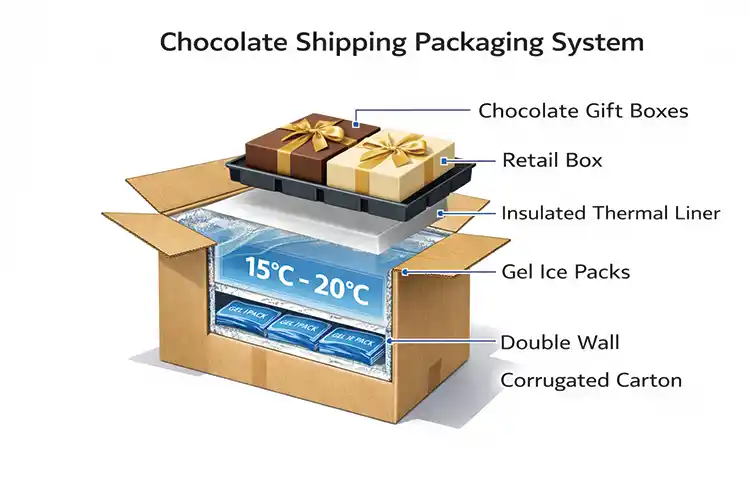
Layered Chocolate Shipping Packaging System
The Engineering of the Cooling Box
Packaging for chocolate export usually starts with the inner structure. Many brands use custom trays made from plastic or molded pulp. These trays hold each chocolate piece in position and reduce vibration.
If chocolates move during transport, their surfaces may develop marks. This happens when chocolates rub against each other or against the tray.
The next layer is insulation. Many companies try to reduce costs in this area, but insulation plays an important role. Multi-layer thermal liners are common. These liners usually combine reflective foil and bubble insulation, similar to many foil‑lined insulated chocolate shipping boxes 5 used in the cold‑chain industry.
Industry packaging comparisons often show a large temperature difference between insulated and non-insulated cartons when exposed to strong heat. Insulation layers can significantly slow down the temperature rise inside the package.
My Recommended Packaging Stack
| Layer | Material Choice | Expert Reason |
|---|---|---|
| Inner Tray | PET or Molded Pulp | Prevents movement and surface damage |
| Thermal Liner | Metallized Bubble | Reflects radiant heat |
| Outer Box | Double-wall Corrugated | Provides stacking protection |
Packaging designers also consider the customer experience. Premium chocolate brands want the package to look clean and professional. Some brands hide insulation behind printed liners so the inside still looks elegant when customers open the box.
Do Insulated Liners or Ice Packs Actually Work?
Yes, insulated liners and gel packs can work effectively when used together. The liner slows heat entering the box, while gel packs absorb the heat that reaches the interior.
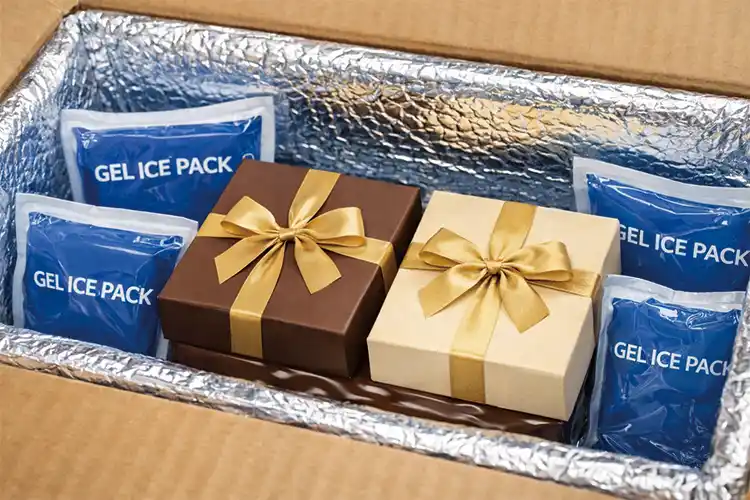
Insulated Chocolate Shipping Box With Gel Packs
Managing Condensation in Chocolate Packaging
Packaging suppliers often hear complaints about wet cartons. This usually happens because of condensation. When a cold gel pack meets warm air, moisture forms on its surface. This moisture can soak into the cardboard.
Cardboard loses much of its strength when it becomes wet. Boxes at the bottom of a pallet may collapse under pressure. This issue appears frequently in humid regions.
One luxury chocolate brand experienced this problem during shipments to Florida. They used large gel packs for cooling. When the shipment arrived, the bottom cartons were wet and weakened.
The solution was to separate moisture from the paperboard. The gel packs and chocolate were sealed inside waterproof plastic liners before placing them inside the carton. Some manufacturers also use moisture-resistant adhesives or wet-strength corrugated materials to improve durability.
Practical Ways to Reduce Moisture
- Use gel packs designed to reduce condensation
- Place waterproof liners between gel packs and cardboard
- Avoid excessive cooling packs
- Leave small air gaps to allow limited air circulation
Some logistics teams also perform environmental tests to estimate cooling duration under high temperatures. These tests help determine whether the cooling materials can last for the entire shipping period.
What Box Structure Protects Chocolate During Export?
Double-wall corrugated cartons combined with internal stabilization provide strong protection for chocolate exports. This structure supports stacking loads and reduces vibration damage during transport.
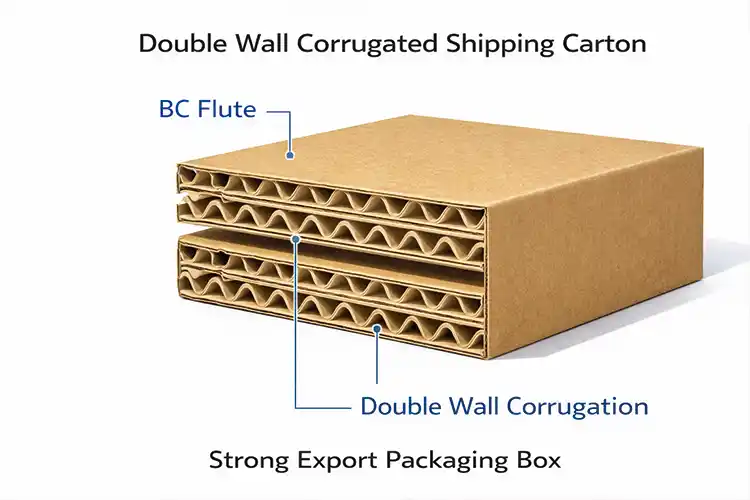
Chocolate Export Carton Structure
Understanding Stacking Strength
In export logistics, boxes often sit on pallets under heavy loads. The bottom boxes must support the weight of all the boxes above them.
If a single-wall carton is used, it may collapse under pressure. When this happens, the chocolate inside can become crushed or damaged.
Double-wall corrugated board adds an extra layer of fluting. This structure increases rigidity and stacking strength.
Different flute types provide different benefits. B-flute offers strong crush resistance. C-flute provides good stacking strength. Many export cartons combine both into BC-flute for improved performance.
Why Structural Design Matters
| Feature | Common Export Standard | Why It Matters |
|---|---|---|
| Wall Type | Double-wall (5 layers) | Prevents collapse during stacking |
| Paper Weight | 200gsm+ Kraft paper | Improves tear resistance |
| Corner Guards | Hardboard inserts | Protects edges from impact |
Transport vibration is another challenge. Long-distance trucking creates constant movement. This vibration can cause chocolates to shift or rub against each other.
To reduce this risk, many packaging systems include internal partitions made from rigid cardboard. These partitions keep retail boxes in place and reduce movement during transport.
Conclusion
Shipping chocolate internationally requires careful control of heat, moisture, and pressure.
A strong corrugated box, proper insulation, controlled cooling packs, and stable inserts work together to protect chocolate during long-distance transport.
-
Understand real transport temperatures and why chocolate needs temperature‑controlled shipping solutions. ↩
-
Get a brand‑friendly checklist on timing, carriers, insulation, and labeling to keep chocolate from melting. ↩
-
Learn ideal storage temperatures and conditions professional chocolatiers use to keep chocolate stable. ↩
-
See a clear table comparing the melting ranges of dark, milk, and white chocolate. ↩
-
See real insulated box kits with foil liners and gel packs designed specifically for shipping chocolate. ↩