跳到内容
跳到内容 
I see bakery owners lose money every day because of bad delivery. Cakes collapse or the frosting gets ruined. Most of these problems happen because the packaging is too weak. Good delivery packaging is like armor for your sweets.
Bakery delivery packaging must protect cakes during a bumpy ride. You need corrugated boxes and inserts [^1] to stop the product from moving. This prevents the cake from hitting the lid or sliding around during the delivery trip.
Online sales are growing fast. But delivery is much harder on a box than a walk-in customer is. I will explain how the right box structure fixes these problems.
Retail Boxes vs. Delivery Boxes: The Big Difference
Many bakeries use the same box for the shop and for delivery. This is a mistake. A shop box only needs to look pretty. A delivery box must be strong enough to stay in one piece during a long drive.
In my factory, I tell my clients this: Retail boxes are made for "carrying." Delivery boxes are made for "stacking." Last month, a customer used a thin paper box for a delivery order. A delivery driver put another package on top of it. The box crushed instantly and ruined the $60 cake.
Retail packaging is thin. Delivery packaging must resist pressure and shaking. You need corrugated board for online orders.
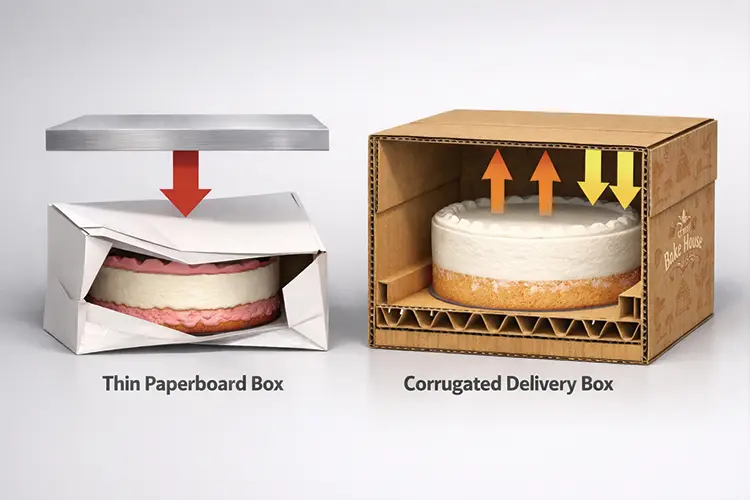
Retail paperboard vs corrugated delivery box structure
Comparison Table: Performance Metrics
| Feature | Shop Pickup | Online Delivery |
|---|---|---|
| Travel Distance | Very Short | Very Long |
| Stacking Risk | No | Yes (High) |
| Vibration | Low | High and Constant |
| Box Material | Thin Paper | Strong Corrugated Board |
Why Do Cakes Actually Collapse?
Many people think cakes collapse because the bread is soft. That is usually not true. Most damage happens because the box cannot handle the pressure of the van.
Cakes collapse because of stacking pressure and shaking [^2]. If the box is weak, it will bend. If the cake is loose inside, it will slide.
I once saw a bakery use a box that was too big for their cake. They did not use an insert to hold the cake still. The delivery bike hit a few bumps. The cake "walked" across the bottom of the box. By the time it arrived, the side of the cake was smashed against the wall.
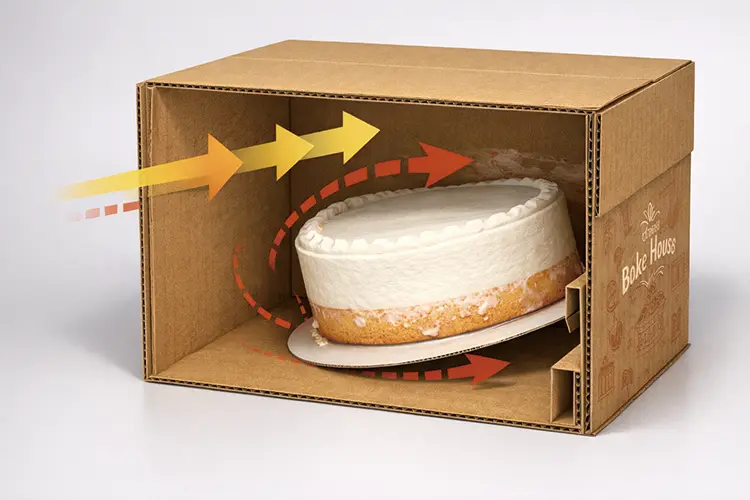
Cake sliding inside an oversized delivery box
Common Risks on the Road
- Stacking: Other heavy boxes push down on your cake box.
- Vibration: The engine and the road make the cake move slowly.
- Sudden Stops: The cake slides forward and hits the front of the box.
The solution is a better box structure. Strong corrugated walls hold the weight of other packages. A good insert [^2] keeps the cake in the center of the box.
What Box Structures Work Best for Bakery Delivery?
I see one pattern again and again. A box that looks fine in the shop fails on the road. That is because pickup boxes are built for “carry.” Delivery boxes are built for “stack.”
For online orders, corrugated cake boxes protect better because they resist stacking pressure and reduce damage from vibration.
Last quarter, one client used a folding carton for local delivery to save cost. It looked great at the counter. But in the driver’s bag, it got squeezed between two food orders. The lid bent, and the frosting touched the top. The cake arrived with a clean box and a ruined surface. That is the worst kind of loss.
Corrugated board fixes this because of the flute layer [^3]. The wavy middle works like tiny pillars. It holds the wall shape under load. It also absorbs small shocks on bumpy roads.

Corrugated flute structure supporting vertical compression
Common Box Structures for Cake Delivery
| Box Structure | Protection Level | Best Use Case |
|---|---|---|
| Folding Carton | Low | Store pickup only |
| E-Flute Corrugated Box | Medium | Short local delivery |
| B-Flute Corrugated Box | High | Courier or bike delivery |
| Double-Wall Corrugated | Very High | Heavy cakes or long routes |
If you want one simple rule, use this. The longer the route, the stronger the flute. For most online bakery orders, E-flute or B-flute corrugated is the safest place to start.
When Should You Use Double-Wall Boxes?
If you sell heavy cakes, tall cakes, or multi-tier cakes, do not gamble. I suggest a double-wall corrugated box plus a locking cake board. This combo fights two enemies at once: crushing from above and sliding inside the box.
A strong outer box is not the full solution. But it is the first line of defense.
The Science Behind Packaging Failure
To truly stop damage, you must understand the physics of a delivery van. It is not just about a "sturdy box." It is about how the material reacts to force, moisture, and motion.
1. Understanding Compression Strength (Vertical Load)
In a delivery warehouse, boxes are stacked 5 to 10 layers high. The box at the bottom must support the weight of everything above it. We measure this using the BCT (Box Compression Test) [^4].
If you use a standard folding carton, the vertical fibers are too thin. They buckle under less than 10kg of pressure. A B-Flute corrugated box, however, uses a "truss" system. The wavy middle layer acts like vertical pillars in a building.
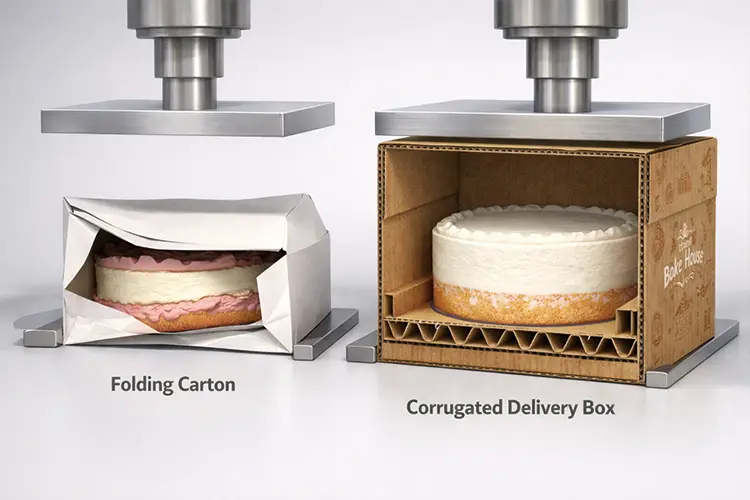
Corrugated flute structure increasing box compression strength
| Material Type | Wall Thickness | Safe Stacking Height | Best For |
|---|---|---|---|
| 350gsm White Card | ~0.5mm | 2 boxes | Cupcakes (Light) |
| E-Flute Corrugated | ~1.5mm | 5 boxes | Standard 6-inch cakes |
| B-Flute Corrugated | ~3.0mm | 10+ boxes | Multi-tier / Heavy cakes |
2. The "G-Force" Problem: Why Inserts are Mandatory
When a delivery bike hits a bump or brakes suddenly, the cake experiences G-force. If there is a 1-inch gap between the cake board and the box wall, that cake becomes a "projectile."
| Insert Method | Mechanism | Expert Rating |
|---|---|---|
| Friction Fit | The board is jammed into the box corners. | 3/5 - Good for short trips. |
| Die-Cut Locking [^5] | The board snaps into a pre-cut slot in the base. | 5/5 - Best for bike delivery. |
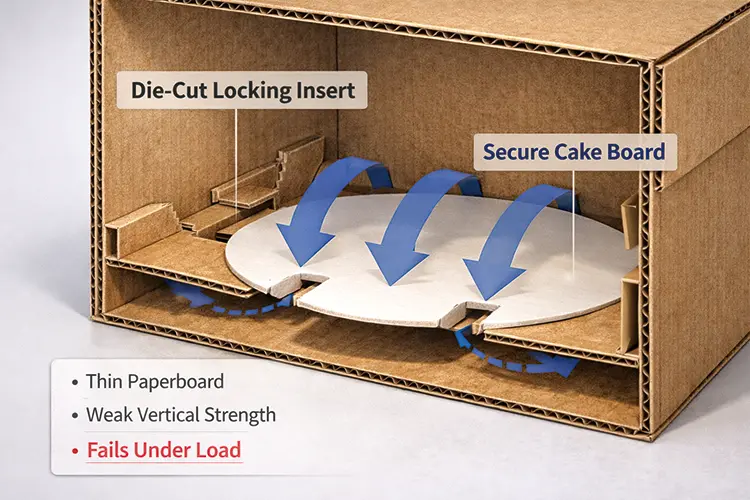
Locking insert system preventing cake movement
3. Hygroscopy: How Humidity Destroys Your "Armor"
Paper is hygroscopic, meaning it drinks water from the air. In a humid kitchen or a rainy delivery run, a standard box will absorb moisture.
A box that is 100% strong in a dry warehouse can lose 50% of its strength in 30 minutes of high humidity. In our factory, we offer three levels of moisture protection:
- Level 1 (Standard): No coating. Use only for dry, 5-minute pickups.
- Level 2 (Varnish): A light spray. Good for short delivery runs.
- Level 3 (PE/BOPP Film): A plastic or bio-film lamination. This is the only way to ensure the box stays stiff during an hour-long delivery in rainy weather.
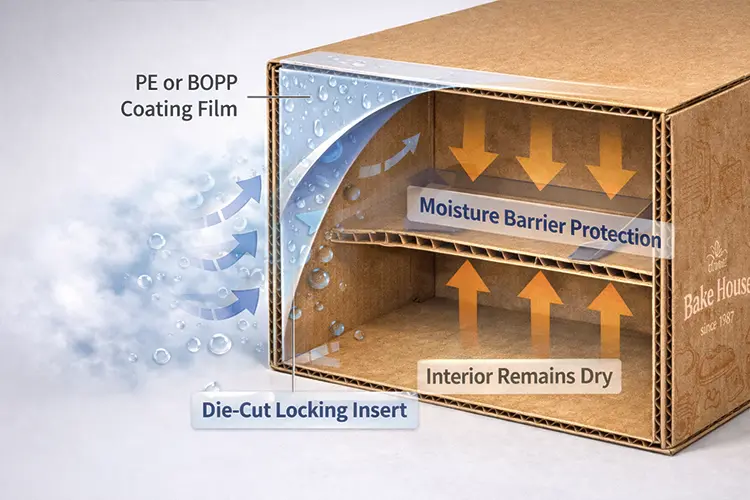
Moisture-resistant laminated bakery delivery box
FAQ: Bakery Delivery Problems Solved
How do I stop a cake from sliding if the box is too big?
You should never leave empty space. If the box is too big, use a custom cardboard insert or a "locking" cake board. I always tell my clients: if the cake can move even half an inch, it is already broken.
Is a corrugated box really worth the extra cost?
Yes. Think of it as insurance. A standard paper box is cheap, but one ruined cake costs you the ingredients, the labor, and a unhappy customer. Corrugated boxes have "flutes" that act like tiny pillars to hold the weight of other delivery bags.
How do I handle delivery in very hot or humid weather?
Humidity makes regular cardboard soft. If you operate in a damp area, you need boxes with a "High-Compression" rating or a PE coating. This coating acts as a moisture barrier to keep the box stiff.
Why did my cake board bend during the delivery?
This usually happens because the board is too thin for the weight of the cake. For heavy cakes, you need a "corrugated" cake board or a "double-wall" board. If the board bends, the cake cracks.
Conclusion
Strong delivery packaging is a calculation, not a guess. To stop 99% of damage, you must match your Box Flute (Strength) to your Insert Design (Movement) and your Coating (Environment). When these three things work together, your cakes will arrive exactly as the decorator intended.
Would you like me to help you calculate the exact Edge Crush Test (ECT) [^7] rating your boxes need based on your average cake weight?
[1]: Learn how corrugated boxes and inserts provide superior protection for cakes during delivery, preventing movement and damage.
[2]: Explore how stacking pressure and shaking can ruin cakes during delivery and how to mitigate these risks.
[3]: Discover how the flute layer in corrugated boxes provides structural support and shock absorption.
[4]: Learn how the BCT measures a box's ability to withstand vertical pressure, crucial for safe cake delivery.
[5]: Discover how Die-Cut Locking systems secure cakes in place, preventing movement during delivery.
[6]: Understand how the ECT rating helps determine the strength needed for safe cake delivery packaging.