跳到内容
跳到内容 
I’ve spent years on factory floors watching premium coffee beans get packed into beautiful bags, only to see them "slump" and disappear once they hit a grocery shelf. Coffee brands invest heavily in high-end foils and matte finishes, yet many still fail the "three-second rule" in-store. The reality is simple: if the shelf lip covers your logo, your branding budget is wasted. Display packaging is the bridge between a warehouse pallet and a customer’s shopping cart.
Coffee retail display packaging utilizes rigid structures to elevate products above shelf obstructions, organize facings into high-impact "visual blocks," and ensure products remain upright. The right display box doesn't just hold the product; it acts as a silent salesperson that maintains brand integrity even after the morning rush has picked the shelf half-clean.
In a crowded aisle, visibility is a game of millimeters. Retail display packaging is how you win that game. Let’s look at the mechanics behind it.
What Is Coffee Retail Display Packaging?
I often encounter brand owners who view packaging strictly as a "protective shell." This mindset is a missed opportunity. In the high-stakes environment of a supermarket or a boutique cafe, your outer box is actually a structural merchandising tool.
In technical terms, coffee retail display packaging refers to retail-ready secondary packaging 1 engineered to transition from shipping to selling with zero friction.. These structures, often made of E-flute or B-flute corrugated board 2, ensure bags stay front-facing and vertical, preventing the "domino effect" where one fallen bag ruins an entire row.
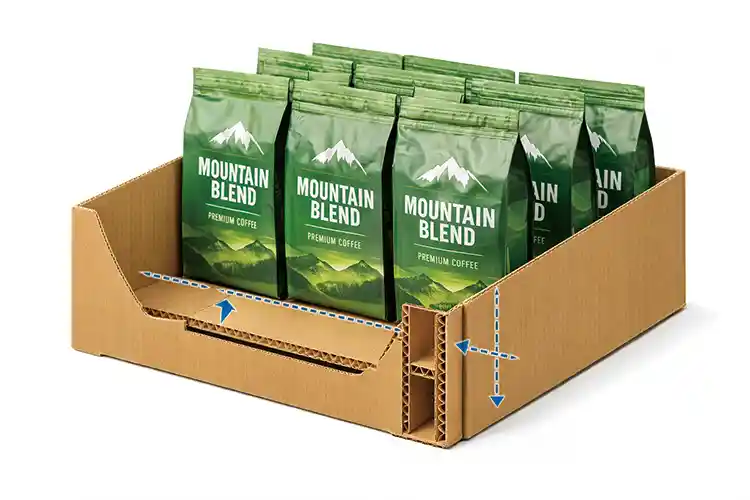
Coffee Retail Display Packaging Structure
Understanding Retail Display Packaging
Walk into any high-traffic retailer like Sam's Club or Costco, and you'll see that products rarely sit "loose" on a shelf. They are grouped. This grouping creates a "billboard effect" that guides a shopper’s eye toward your brand before they can even read the text on the bag.
Expert Insight: I recently worked with a specialty roaster whose bags were consistently hidden by 2-inch shelf price rails. By switching to a stepped-base display tray, we physically lifted the product by 30mm. That tiny structural adjustment meant their logo was finally visible from the end of the aisle, not just from six inches away.
Why Coffee Brands Use Display Packaging
Display packaging solves the "real world" problems that generic mockups ignore.
| The Retail Reality | The Engineering Solution |
|---|---|
| Shelf edges/rails hide branding | Elevated "False Bottom" or Tiered Trays |
| Stand-up pouches "slump" over time | Rigid side-walls for lateral support |
| Inventory looks "shopped" and messy | Gravity-fed or slotted alignment |
| Store staff take too long to restock | "Easy-tear" Perforated SRP structures |
Flexible pouches are notorious for losing their shape as the coffee settles. A dedicated display tray acts as a "corset" for these bags, keeping them crisp, upright, and professional throughout the day.
Types of Coffee Products That Use Display Packaging
| Coffee Format | Structural Display Strategy |
|---|---|
| Drip coffee / Pour-over bags | Gravity-fed Counter Displays (PDQ) |
| Espresso Capsules | Shelf-Ready Packaging (SRP) with die-cut inserts |
| Instant sachets | Multi-tier "Stadium" trays |
| 12oz / 1kg Whole Bean Bags | Heavy-duty corrugated "Case-to-Shelf" shippers |
How Display Packaging Supports Retail Merchandising
Retailers prioritize "Stocking Velocity." If a clerk has to spend five minutes hand-aligning twenty individual bags of coffee, they’ll hate your brand. The same problem shows up for food and chocolate packaging that relies on loose pouches without display trays.
If they can tear off a perforated lid and slide an entire 10-pack onto the shelf in three seconds, you’ve just become their favorite supplier.
I tell my clients: Packaging isn't just for the consumer; it’s for the stock clerk. A "Retail Ready" design ensures your brand is always presented exactly how you intended, rather than leaning sideways or hidden at the back of the shelf.
Why Do Many Coffee Products Disappear on Retail Shelves?
The "invisible product" syndrome is a nightmare for roasters. You can have the world's best 90+ point Gesha coffee, but if it’s sitting in a visual dead zone, it won’t move.
Coffee products usually disappear because of "Shelf-Shadowing"—where the shelf above or the price rail below physically blocks light and line-of-sight. Display packaging counters this by "pushing" the product forward and upward into the light.
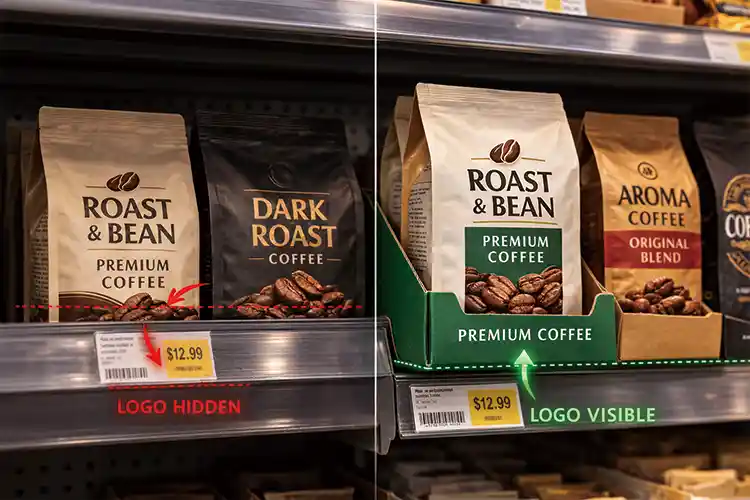
Retail Shelf Visibility Challenge
The "Shelf Lip" Problem
Standard retail shelves have a metal or plastic lip to hold price tags. This lip is the enemy of the stand-up pouch. If your brand name is printed on the bottom third of the bag, it effectively doesn't exist to the shopper. We solve this in the factory by calculating the "Viewable Zone" and building the display tray to lift the product accordingly.
The "Slump" and The "Lean"
Coffee bags are top-heavy. As customers pick them up and put them back, the remaining bags start to lean. This creates a "messy shelf" signal to the brain, which shoppers subconsciously associate with lower quality. A structural tray provides lateral tension, ensuring that even when only two bags are left, they are still standing at attention.
Small Structural Changes, Big ROI
In my factory audits, I often show brands how a simple 45-degree angled side-wall on a display box can change everything. It provides the strength of a shipping box but dips down at the front to reveal 90% of the product's face.
What Types of Retail Display Packaging Work Best for Coffee?
Coffee brands typically use three types of retail display packaging: counter display boxes (PDQ), shelf ready packaging (SRP), and floor display units (FSDU). Each structure is designed to organize products, improve shelf visibility, and make restocking easier for retail staff.
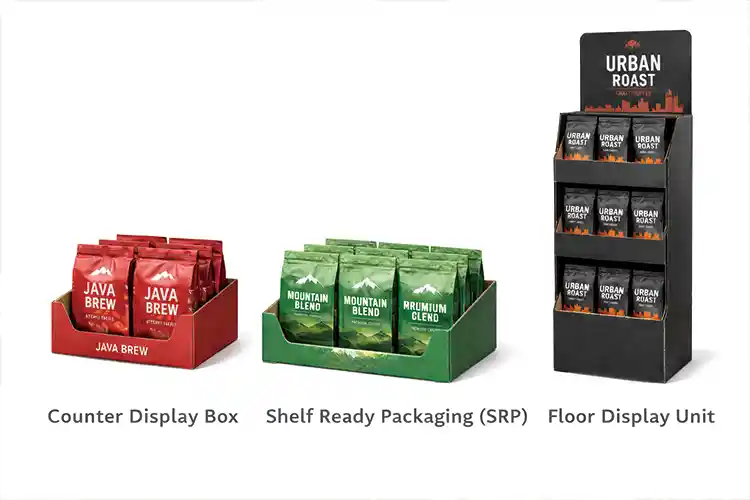
Coffee Display Packaging Types
Counter Display Boxes (PDQ)
Usually found at the Point of Purchase (POP), PDQ counter displays 3 are perfect for impulse buys like single-serve steepable bags.. We design these with a "pop-up" header—a piece of the box that folds up to provide extra branding space without increasing the footprint.
Shelf Ready Packaging (SRP)
This is the workhorse of the supermarket – [shelf‑ready packaging]https://folenepackaging.com/blog/shelf-ready-packaging/) 4 that arrives as a shipping case and transforms into a display.. The key here is the perforation quality. If the perforation is too strong, the clerk rips the box; if it's too weak, it falls apart in transit. A factory expert knows the "Goldilocks" tear-strength for 200lb-test corrugated board.
Floor Display Units (FSDU)
For big seasonal promotions or "Special Buys," you need a standalone tower. These are essentially pieces of furniture made of cardboard. For heavy coffee bags, we reinforce these with internal support pillars to prevent the bottom shelves from buckling under the weight.
How Does Display Packaging Improve Shelf Visibility?
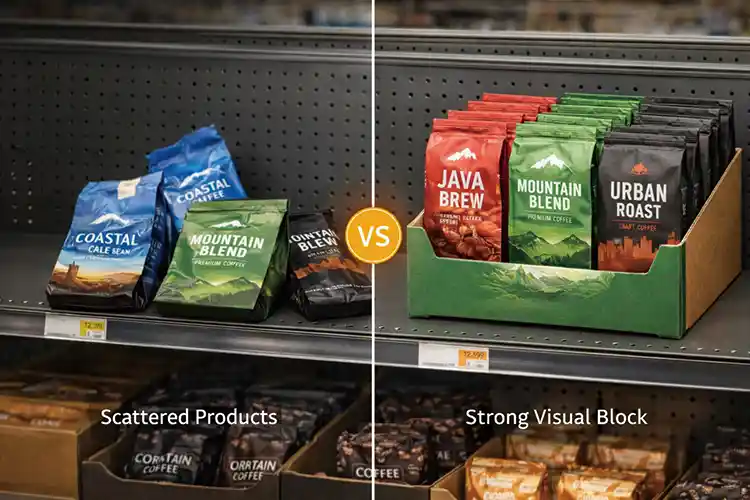
Improving Coffee Shelf Visibility
The Power of the "Visual Block"
Human eyes are scanners, not readers. We look for patterns. When you put six bags of coffee in a bright, structurally consistent tray, you create a "Color Block." This is much easier for the brain to register than six individual bags.
"Automatic" Facing
Some advanced display structures use a gravity‑fed display system 5. As the front bag is taken, the next one slides forward.. This ensures your "facing" is always full. In a busy store, a brand that stays at the front of the shelf will outsell a brand that gets pushed to the back every time.
Factory Case Study: We helped a cold brew concentrate brand that was struggling with "bottles rattling." By designing a tray with integrated die-cut dividers, we not only stopped the breakage but ensured every bottle label faced exactly 0° forward. The result was a 25% uptick in sales simply because the brand looked "organized and premium" compared to the cluttered competition.
Conclusion
At the end of the day, coffee retail display packaging isn't about "decorating" a box. It’s about retail engineering. It’s the difference between your product being a "shelf-warmer" or a "best-seller." Before you finalize your next packaging run, ask yourself: "Is my structure working as hard as my coffee?"
-
Learn what retail‑ready packaging means and how it’s defined in modern retail. ↩
-
See specs and use‑cases of E‑flute board for retail packaging and displays. ↩
-
View PDQ counter display examples and how they’re used at checkout areas. ↩
-
Discover SRP benefits with real retail examples and implementation tips. ↩
-
Learn how gravity‑fed systems keep shelves front‑faced and support sustainable, low‑waste retail. ↩